Fill Out a Valid Florida Dot Medical Template
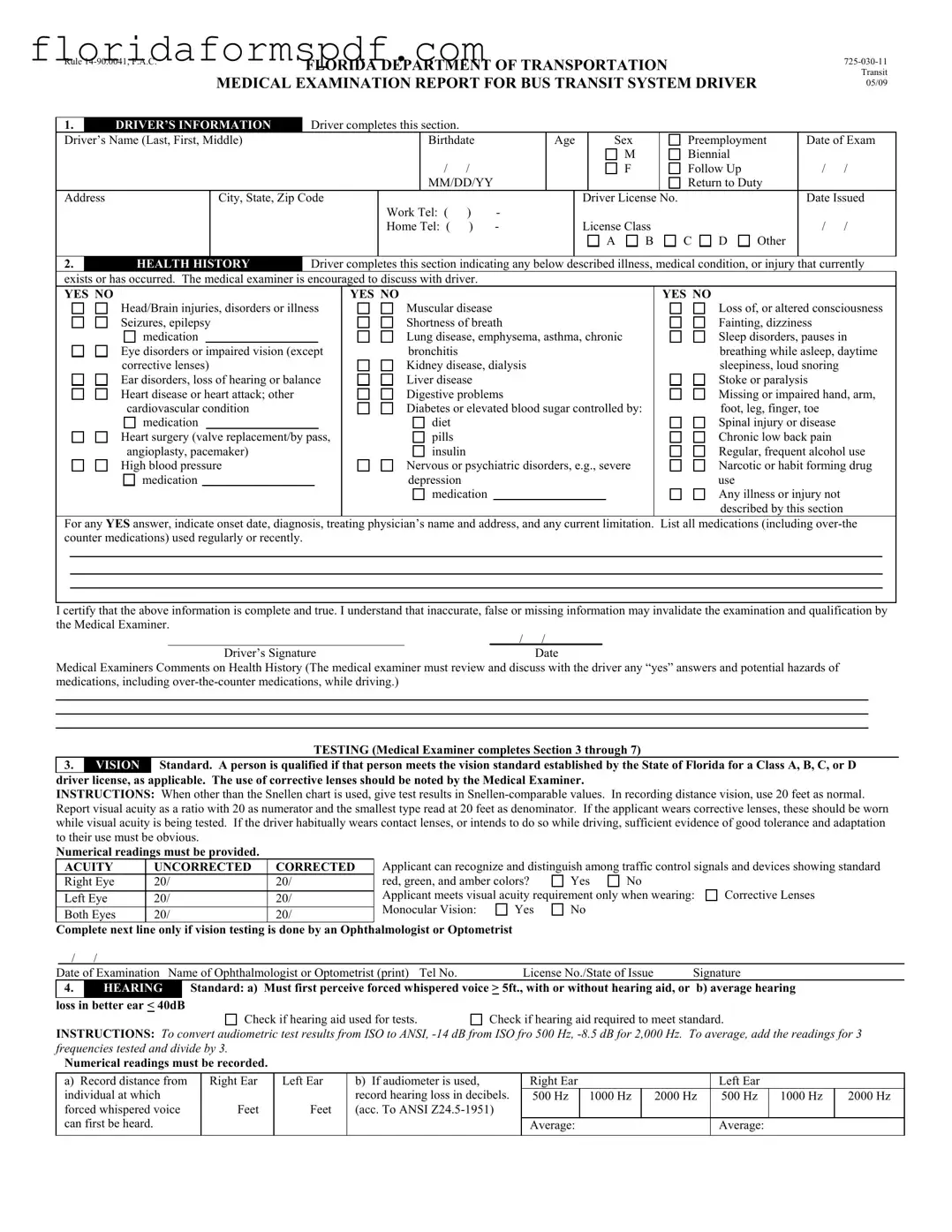
The Florida Department of Transportation Medical Examination Report for Bus Transit System Driver, known as the Florida DOT Medical form, plays a crucial role in ensuring the safety and well-being of bus drivers and their passengers by setting stringent health requirements for drivers. This comprehensive document outlines several key sections including the driver's personal information, an in-depth health history review, and a variety of medical examinations ranging from vision and hearing standards to laboratory tests and a full physical examination. Drivers are required to disclose any existing or past illnesses, medical conditions, or injuries, while medical exambut not limitedto visual and auditory acuity, blood pressure and pulse rate evaluations, and detailed laboratory findings which aim to identify any underlying medical issues that could impair driving capabilities. Furthermore, this form mandates the investigation of any neurological, cardiovascular, or respiratory conditions that could lead to sudden incapacitation, ensuring only those who meet the specific health standards are deemed fit to operate a bus. The precise aim of this physical examination is delineated within the guidelines, with an emphasis on transparent communication between the driver and the medical examiner to ascertain if any medical supervision is necessary for conditions that could affect the driver’s ability to safely drive a bus. This document not only serves to validate the health and fitness of bus drivers in Florida but also acts as a protective measure for the general public by preventing potential accidents on the road.
Document Preview Example

Rule
FLORIDA DEPARTMENT OF TRANSPORTATION
MEDICAL EXAMINATION REPORT FOR BUS TRANSIT SYSTEM DRIVER
1. |
|
DRIVER’S INFORMATION |
Driver completes this section. |
|
|
|
|
|
|
|
|
|
|
|
|
|
|
|||||||||
Driver’s Name (Last, First, Middle) |
|
|
|
|
|
Birthdate |
|
Age |
|
|
Sex |
|
|
Preemployment |
Date of Exam |
|||||||||||
|
|
|
|
|
|
|
|
|
|
|
|
|
|
|
|
|
|
|
M |
|
|
Biennial |
|
|
|
|
|
|
|
|
|
|
|
|
|
|
|
|
/ |
/ |
|
|
|
|
|
F |
|
|
Follow Up |
|
/ |
/ |
|
|
|
|
|
|
|
|
|
|
|
|
|
MM/DD/YY |
|
|
|
|
|
|
|
|
Return to Duty |
|
|
|||
Address |
|
|
|
|
City, State, Zip Code |
|
|
|
|
|
|
|
Driver License No. |
|
|
Date Issued |
||||||||||
|
|
|
|
|
|
|
|
|
|
|
Work Tel: ( |
) |
- |
|
|
|
|
|
|
|
|
|
|
|
|
|
|
|
|
|
|
|
|
|
|
|
|
Home Tel: ( |
) |
- |
|
|
License Class |
|
|
|
/ |
/ |
|||||
|
|
|
|
|
|
|
|
|
|
|
|
|
|
|
|
|
|
|
A |
B |
C |
D |
Other |
|
|
|
|
|
|
|
|
|
|
|
|
|
|
|
|
|
|
|
|||||||||||
2. |
|
HEALTH HISTORY |
Driver completes this section indicating any below described illness, medical condition, or injury that currently |
|||||||||||||||||||||||
exists or has occurred. The medical examiner is encouraged to discuss with driver. |
|
|
|
|
|
|
|
|
|
|
|
|
|
|||||||||||||
YES NO |
|
|
|
|
|
|
|
|
YES NO |
|
|
|
|
|
|
|
|
|
YES NO |
|
|
|
|
|||
|
|
Head/Brain injuries, disorders or illness |
|
Muscular disease |
|
|
|
|
|
|
|
|
|
Loss of, or altered consciousness |
||||||||||||
|
|
Seizures, epilepsy |
|
|
|
|
Shortness of breath |
|
|
|
|
|
|
Fainting, dizziness |
|
|||||||||||
|
|
medication |
|
|
|
|
|
Lung disease, emphysema, asthma, chronic |
|
|
|
Sleep disorders, pauses in |
||||||||||||||
|
|
Eye disorders or impaired vision (except |
|
bronchitis |
|
|
|
|
|
|
|
|
|
|
breathing while asleep, daytime |
|||||||||||
|
|
corrective lenses) |
|
|
|
|
Kidney disease, dialysis |
|
|
|
|
|
|
sleepiness, loud snoring |
|
|||||||||||
|
|
Ear disorders, loss of hearing or balance |
|
Liver disease |
|
|
|
|
|
|
|
|
|
Stoke or paralysis |
|
|||||||||||
|
|
Heart disease or heart attack; other |
|
|
|
|
Digestive problems |
|
|
|
|
|
|
Missing or impaired hand, arm, |
||||||||||||
|
|
cardiovascular condition |
|
|
|
|
Diabetes or elevated blood sugar controlled by: |
|
|
|
foot, leg, finger, toe |
|
||||||||||||||
|
|
medication |
|
|
|
|
|
|
diet |
|
|
|
|
|
|
|
|
|
|
Spinal injury or disease |
|
|||||
|
|
Heart surgery (valve replacement/by pass, |
|
|
pills |
|
|
|
|
|
|
|
|
|
|
Chronic low back pain |
|
|||||||||
|
|
angioplasty, pacemaker) |
|
|
|
|
|
insulin |
|
|
|
|
|
|
|
|
|
|
Regular, frequent alcohol use |
|||||||
|
|
High blood pressure |
|
|
|
|
Nervous or psychiatric disorders, e.g., severe |
|
|
|
Narcotic or habit forming drug |
|||||||||||||||
|
|
medication |
|
|
|
|
depression |
|
|
|
|
|
|
|
|
|
|
use |
|
|
|
|||||
|
|
|
|
|
|
|
|
|
|
|
|
medication |
|
|
|
|
|
|
|
|
|
Any illness or injury not |
|
|||
|
|
|
|
|
|
|
|
|
|
|
|
|
|
|
|
|
|
|
|
|
|
|
described by this section |
|
||
For any YES answer, indicate onset date, diagnosis, treating physician’s name and address, and any current limitation. List all medications (including
I certify that the above information is complete and true. I understand that inaccurate, false or missing information may invalidate the examination and qualification by
the Medical Examiner. |
|
|
______________________________________ |
/ |
/ |
Driver’s Signature |
|
Date |
Medical Examiners Comments on Health History (The medical examiner must review and discuss with the driver any “yes” answers and potential hazards of medications, including
TESTING (Medical Examiner completes Section 3 through 7)
3. VISION Standard. A person is qualified if that person meets the vision standard established by the State of Florida for a Class A, B, C, or D driver license, as applicable. The use of corrective lenses should be noted by the Medical Examiner.
INSTRUCTIONS: When other than the Snellen chart is used, give test results in
Numerical readings must be provided.
ACUITY |
UNCORRECTED |
CORRECTED |
Applicant can recognize and distinguish among traffic control signals and devices showing standard |
||||||
Right Eye |
20/ |
20/ |
red, green, and amber colors? |
Yes |
No |
|
|
||
|
|
|
Applicant meets visual acuity requirement only when wearing: |
Corrective Lenses |
|||||
Left Eye |
20/ |
20/ |
|||||||
Monocular Vision: |
Yes |
No |
|
|
|
||||
Both Eyes |
20/ |
20/ |
|
|
|
||||
|
|
|
|
|
|
||||
Complete next line only if vision testing is done by an Ophthalmologist or Optometrist |
|
|
|
|
|
||||
/ / |
|
|
|
|
|
|
|
|
|
Date of Examination Name of Ophthalmologist or Optometrist (print) Tel No. |
License No./State of Issue |
Signature |
|||||||
4.
HEARING |
Standard: a) Must first perceive forced whispered voice > 5ft., with or without hearing aid, or b) average hearing |
|
|
loss in better ear < 40dB |
|
Check if hearing aid used for tests. |
Check if hearing aid required to meet standard. |
INSTRUCTIONS: To convert audiometric test results from ISO to ANSI,
Numerical readings must be recorded.
a) Record distance from |
Right Ear |
Left Ear |
b) If audiometer is used, |
Right Ear |
|
|
Left Ear |
|
|
individual at which |
|
|
record hearing loss in decibels. |
500 Hz |
1000 Hz |
2000 Hz |
500 Hz |
1000 Hz |
2000 Hz |
forced whispered voice |
Feet |
Feet |
(acc. To ANSI |
|
|
|
|
|
|
can first be heard. |
|
|
|
Average: |
|
|
Average: |
|
|
|
|
|
|
|
|
|
|
|
|
Rule |
Transit 05/09
5. |
|
BLOOD PRESSURE EVALUATION / PULSE RATE |
Numerical readings must be recorded. |
||||||||
Blood |
Systolic |
Diastolic |
Driver qualified if < 160/90 |
|
Pulse |
|
Regular |
|
|||
Pressure |
|
|
on initial exam. |
|
|
|
Rate |
|
Irregular |
|
|
|
|
On initial exam |
|
|
|
|
|
Within 3 months |
|||
If 161 – 180 and/or 91 – 104. qualify 3 mos. only. |
___._ |
|
If < 160 and/or 90, qualify for 1 yr. Document Rx & |
||||||||
|
|
|
control the 3rd month |
||||||||
If > 180 and/or 104, not qualified until reduced to < |
___._ |
|
If < 160 and/or 90, qualify for 6 mos. Document Rx & |
||||||||
|
181/105. Then qualify for 3 mos. only. |
|
|
|
control the 3rd month |
||||||
Medical examiner should take at least 2 readings to confirm blood pressure.
___._
___._
Certify
Annually if acceptable BP is
maintained
Biannually
6.
LABORATORY AND OTHER TEST FINDINGS |
Numerical readings must be recorded. |
Urinalysis is required. Protein, blood or sugar in the urine may be an |
|
SP.GR. |
PROTEIN |
BLOOD |
SUGAR |
indication for further testing to rule out any underlying medical problem. |
URINE SPECIMEN |
|
|
|
|
Diabetes.
diagnosis of diabetes mellitus requiring insulin for control, the person shall not be qualified to drive a bus. Biennial Medical Examination: If diabetes is noted for an existing driver at the time of his or her examination, excluding
7.
PHYSICAL EXAMINATION |
Height: |
|
(in.) Weight: |
|
(lbs.) |
The presence of a certain condition may not necessarily disqualify a driver, particularly if the condition is controlled adequately, is not likely to worsen or is readily amenable to treatment. Even if a condition does not disqualify a driver, the medical examiner may consider deferring the driver temporarily. Also, the driver should be advised to take the necessary steps to correct the condition as soon as possible particularly if the condition, if neglected, could result in more serious illness that might affect driving.
Check YES if there are any abnormalities. Check NO if the body system is normal. Discuss any YES answers in detail in the space below, and indicate whether it would affect the driver’s ability to operate a bus safely. Enter applicable item number before each comment. If organic disease is present, note that it has been compensated for. See Instructions To The Medical Examiner for guidance.
|
BODY |
CHECK FOR: |
YES |
NO |
BODY |
CHECK FOR: |
YES |
NO |
|
|
SYSTEM |
|
|
|
SYSTEM |
|
|
|
|
1. |
General |
Marked overweight, tremor, signs of alcoholism, |
|
|
7. Abdomen and |
Enlarged liver, enlarged spleen, masses, bruits, |
|
|
|
|
Appearance |
problem drinking, or drug abuse. |
|
|
Viscera |
hernia, significant abdominal wall muscle weakness. |
|
|
|
2. |
Eyes |
Pupiltary equality, reaction to light, accommodation, |
|
|
8. Vascular |
Abnormal pulse and amplitude, carotid or arterial |
|
|
|
|
|
|
ocular motility, ocular muscle imbalance, extraocular |
|
|
system |
bruits, varicose veins. |
|
|
|
|
|
movement, nystagmus, exophthalmos, strabismus |
|
|
|
|
|
|
|
|
|
uncorrected by corrective lenses, retinopathy, |
|
|
|
|
|
|
|
|
|
calaracis, aphakia, glaucoma, macular degeneration. |
|
|
|
|
|
|
3. |
Ears |
Middle ear disease, occlusion of external canal, |
|
|
9. |
Hernias. |
|
|
|
|
|
|
perforated eardrums |
|
|
system |
|
|
|
4. |
Mouth and |
Irremediable deformities likely to interfere with |
|
|
10. Extremities- |
Loss of impairment of leg, foot, toe, arm, hand, |
|
|
|
|
Throat |
breathing or swallowing |
|
|
Limb impaired |
finger. Perceptible limp, deformities, atrophy, |
|
|
|
|
|
|
|
|
|
|
weakness, paralysis, clubbing, edema, hypotonia. |
|
|
|
|
|
|
|
|
|
Insufficient grasp and prehension in upper limb to |
|
|
|
|
|
|
|
|
|
maintain steering wheel grip. Insufficient mobility |
|
|
|
|
|
|
|
|
|
and strength in lower limb to operate pedals properly. |
|
|
5. |
Heart |
Murmurs, extra sounds, enlarged heart, pacemaker. |
|
|
11. Spine, other |
Previous surgery, deformities, limitation of motion, |
|
|
|
|
|
|
|
|
|
musculoskeletal |
tenderness. |
|
|
6. |
Lungs and |
Abnormal chest wall expansion, abnormal respiratory |
|
|
12. Neurological |
Impaired equilbrium, coordination or speech pattern; |
|
|
|
|
chest, not |
rates, abnormal breath sounds including wheezes or |
|
|
|
paresthesia, asymmetric deep tendon reflexes, sensory |
|
|
|
|
including breast |
alveolar rates, impaired respiratory function, dyspnea, |
|
|
|
or positional abnormalities, adnormal patellar and |
|
|
|
|
examination. |
cyanosis. Abnormal findings on physical exam may |
|
|
|
Babinski’s reflexes, ataxia. |
|
|
|
|
|
|
require further testing such as pulmonary tests and/or |
|
|
|
|
|
|
|
|
|
xray of chest. |
|
|
|
|
|
|
|
COMMENTS: |
|
|
|
|
|
|
|
|
|
|
|
|
|
|
|
|
|
|
|
|
|
|
|
|
|
|
|
|
|
|
|
|
|
|
|
|
|
|
Note certification status here and on the Medical Examination Certificate. See Instructions to the Medical Examiner and qualification criteria for guidance.
Meets standards |
|
Wearing corrective lenses |
||
Does not meet standards |
|
|
Wearing hearing aid |
|
Meets standards, but periodic evaluation required. |
|
|||
Due to _________________________________ driver qualified only for: |
Temporarily disqualified due to (condition or medication): |
|||
3 months |
6 months |
1 year |
Other |
|
Return to medical examiner’s office for follow up on: |
|
|||
Please provide a completed Medical Examination Certificate to Medical Examiner’s Signature: _______________________________________________ |
||||
the driver’s employer in accordance with |
Medical Examiner’s Name (print): ____________________________________________ |
|||
|
||||
|
MD |
DO |
Physician Assistant |
Advanced Registered Nurse Practitioner |
Driver may request a copy of his/her completed Medical |
Address: _________________________________________________________________ |
|||
Examination Report from the medical examiner. |
Telephone Number: _________________________________________________________ |
|||
|
||||

Rule |
Transit 05/09
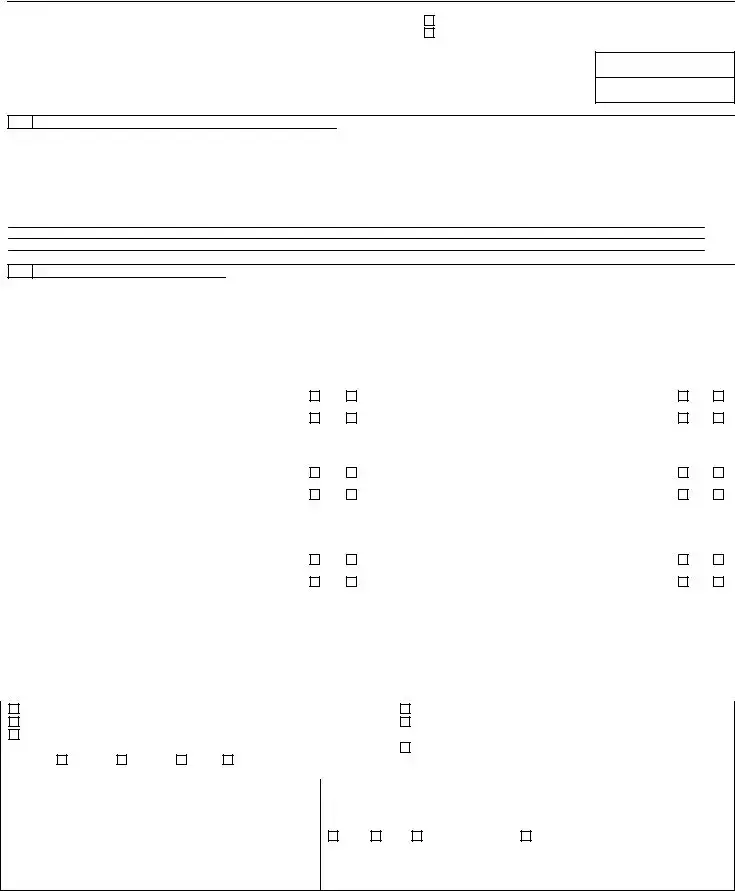
MEDICAL EXAMINATION CERTIFICATE
for Bus Transit System Driver
I certify that I have examined |
|
|
|
|
in accordance with the requirements in Rule |
||
|
|
|
|
|
|||
Florida Administrative Code, and referenced FDOT Form |
|||||||
Note certification status here and on the medical examination form. |
|
|
|
|
If applicable, only when: |
||
MEETS STANDARDS |
|
|
|
|
Corrective Lenses |
||
|
|
|
|
|
|
|
|
DOES NOT MEET STANDARDS |
|
|
|
|
|
Wearing hearing aid |
|
|
|
|
|
|
|
|
|
MEETS STANDARDS, BUT PERIODIC EVALUATION REQUIRED |
|
|
|
|
Temporarily disqualified due to: |
||
|
|
|
|
|
|||
|
|
|
|
|
|
|
|
|
|
DRIVER IS QUALIFIED ONLY FOR: |
|
|
|
|
|
|
|
|
|
|
|
|
|
|
1 YEAR |
OTHER |
|
||||
|
|
|
|
|
|
|
|
Return to medical examiner’s office for |
|
|
|
|
|
|
|
|
|
|
|
|
|
|
|
The information I have provided regarding this physical examination is true and complete. A complete examination form with any attachments embodies my findings completely and correctly, and is on file in my office.
Medical Examiner’s Signature: |
|
Telephone: |
|
Date: |
|
|
|
|
|
|
|
Medical Examiner’s License or certificate number |
|
|
|
|
|
|
|
Medical Examiner’s Name: (Print) |
|
|
|
|
|
|
Issuing State: |
|
|
|
|
|
|
|
|
|
MD |
Physician |
Advanced Registered Nurse |
|
|
DO |
Assistant |
Practitioner |
|
|
|
|
|
Office Address: (Print) |
|
|
|
|
|
|
|
|
|
CITY |
COUNTY |
STATE |
|
ZIP |
|
|
|
|
|
Name of Driver: (Print) |
|
Driver License No. |
|
Issuing State: |
|
|
|
|
|
Signature of Driver: |
|
|
|
Date: |
|
|
|
|
|
Rule |
Transit 05/09
INSTRUCTIONS TO THE MEDICAL EXAMINER
General Information
The purpose of this examination is to determine a driver’s physical qualification to operate a bus according to the requirements in Rule 14- 90.0041, Florida Administrative Code, and referenced Department Form
Advisory and Qualification Standards
Extremities. Carefully examine upper and lower extremities. Note any and all deformities, the presence of atrophy,
Diabetes.
Cardiovascular Condition. A person is qualified if that person has no current clinical diagnosis of myocardial infarction, angina pectoris, coronary insufficiency, thrombosis or any other cardiovascular disease of a variety known to be accompanied by syncope, dyspnea, collapse or congestive heart failure. The term “has no current clinical diagnosis of” is specially designed to encompass: “a clinical diagnosis of” (1) a current cardiovascular condition, or (2) a cardiovascular which has not fully stabilized, regardless of the time limit. The term “known to be accompanied by” is defined to include a clinical diagnosis or cardiovascular disease (1) which is accompanied by symptoms of syncope, dyspnea, collapse or congestive cardiac failure: and/or (2) which is likely to cause syncope, dyspnea, collapse or congestive cardiac failure. The subjective decision of whether the nature and severity of an individual’s condition will likely cause symptoms of cardiovascular insufficiency is on an individual basis and qualification rests with the medical examiner and the bus transit system. In those cases where there is an occurrence of cardiovascular insufficiency (myocardial infarction, thrombosis, etc.), it is suggested before a driver is certified that he or she have a normal resting and stress electrocardiogram (ECG), no residual complications and no physical limitations, and is taking no medication likely to interfere with safe driving. Coronary artery bypass surgery and pacemaker implantation are remedial procedures and thus, not disqualifying. Coumadin is a medical treatment that can improve the health and safety of a driver and should not, by its use, medically disqualify the driver. The emphasis should be on the underlying medical conditions that require treatment and the general health of the driver.
Respiratory Dysfunction. A person is qualified if that person has no established medical history or clinical diagnosis of a respiratory dysfunction likely to interfere with the ability to control and drive a bus safely. Since a driver must be alert at all times, any change in his/her mental state is in direct conflict with highway safety. Even the slightest impairment in respiratory function under emergency conditions (when greater oxygen supply is necessary for performance) may be detrimental to safe driving. There are many conditions that interfere with oxygen exchange and may result in incapacitation, including emphysema, chronic asthma, carcinoma, tuberculosis, chronic bronchitis and sleep apnea. If the medical examiner detects a respiratory dysfunction, which is in any way likely to interfere with the driver’s ability to safely control and drive a bus, the driver must be referred to a specialist for further evaluation and therapy. Anticoagulation therapy for deep vein thrombosis and/or pulmonary thromboebolism is not disqualifying once optimum dosage is achieved, provided lower extremity venous examinations remain normal and the treating physician gives a favorable recommendation.
Hypertension. A person is qualified if that person has no current clinical diagnosis of high blood pressure likely to interfere with the ability to operate a bus safely. A blood pressure of greater then
Since the presence of target damage increases the risk of sudden collapse, group 3 or 4 hypertensive retinopathy, left ventricular hypertrophy not otherwise explained (echocardiography or ECG by Estes criteria) evidence of severely reduced left ventricular function, or serum creatinine of greater then 2.5 warrants the driver being found unqualified to operate a bus. Treatment nonpharmacologic and pharmacologic modalities as well as counseling to reduce other risk factors. Most
Rule |
Transit 05/09
an individual basis. Individuals must be alerted to the hazards of these medications while driving. Side effects of somnolence or syncope are particularly undesirable in bus drivers. A driver who has normal blood pressure 3 or more months after a successful operation for pheochromocytoma, primarily aldosteronism (unless bilateral adrenalectomy has been performed), renovascular disease or unilateral renal parenchymal disease, and who shows no evidence of target organ may be qualified. Hypertension that persists, despite surgical intervention, should be evaluated and treated following the guidelines set forth in this section.
Rheumatic, Arthritic, Orthopedic, Muscular, Neuromuscular or Vascular Disease. A person is qualified if that person has no established medical history or clinical diagnosis of Rheumatic, Arthritic, Orthopedic, Muscular, Neuromuscular or Vascular Disease, which interferes with the ability to control and operate a bus safely. Certain diseases are known to have acute episodes of transient muscle weakness, poor muscle coordination (ataxia), abnormal sensations (paresthesia) decreased muscular tone (hypotonia) visual disturbances and pain which may be suddenly incapacitating. With each recurring episode, these symptoms may become more pronounced and remain for longer periods of time. Other diseases have more insidious onsets and display symptoms of muscle wasting (atrophy) swelling and paresthesia which may not suddenly incapacitate a person but may restrict his/her movement and eventually interfere with the ability to drive safely. In many instances these diseases are degenerative in nature or may result in the deterioration of the involved area. Once the individual has been diagnosed with having Rheumatic, Arthritic, Orthopedic, Muscular, Neuromuscular or Vascular Disease, then he/she has an established history of that disease. The physician when examining the individual should consider the following: (1) the nature and severity of the individual’s condition (such as sensory loss or loss of strength); (2) the degree of the limitation present (such as range of motion); the likelihood of progressive limitation (not always present initially, but may manifest itself over time); and (4) the likelihood of sudden incapacitation. If severe functional impairment exists, the driver does not qualify. In cases when more frequent monitoring is required, a certificate for a shorter time period may be issued.
Epilepsy. A person is qualified if that person has no established medical history or clinical diagnosis of epilepsy or any other condition which is likely to cause loss of consciousness or any loss of ability to control a bus. Epilepsy is a chronic functional disease characterized by seizures or episodes that occur without warning, resulting in loss of voluntary control that may lead to loss of consciousness and/or seizures. Therefore, the following drivers cannot be qualified: (1) a driver who has a medical history of epilepsy; or (2) a driver who has a current clinical diagnosis of epilepsy; or (3) a driver who is taking
Mental Disorders. A person is qualified if that person has no mental, nervous, organic or functional disease or psychiatric disorder likely to interfere with ability to drive a bus safely. Emotional or adjustment problems contribute directly to an individual’s level of memory, reasoning, attention and judgment. These problems often underlie physical disorders. A variety of functional disorders can cause drowsiness, dizziness, confusion, weakness or paralysis that may lead to uncoordination, inattention, loss of functional control and susceptibility to accidents while driving. Physical fatigue, headache, impaired coordination, recurring physical ailments and chronic “nagging” pain may be present to such a degree that certification for driving is inadvisable. Somatic and psychosomatic complaints should be thoroughly examined when determining an individual’s overall fitness to drive. Disorders of a periodical incapacitating nature, even in the early stages of development, may warrant disqualification. Many bus drivers have documented that “nervous trouble” related to neurotic, personality, emotional or adjustment problems is responsible for a significant fraction of their preventable accidents. The degree to which an individual is able to appreciate, evaluate and adequately respond to environmental strain and emotional stress is critical when assessing an individual’s mental alertness and flexibility to cope with the stresses of driving a bus. When examining the driver, it should be kept in mine that individuals who live under chronic emotional upsets might have deeply ingrained maladaptive or erratic behavior patterns. Excessively antagonistic, instinctive, impulsive, openly aggressive, paranoid or severely depressed behavior may greatly interfere with the drivers ability to drive safely. Those individuals who are highly susceptible to frequent states of emotional instability (schizophrenia, affective psychoses, paranoia, anxiety or depressive neuroses) may warrant disqualification. Careful consideration should be given to the side effects and interactions of medications in the overall qualification determination.
Vision. A person is qualified if that person meets the vision standard established by the State of Florida for Operator and Commercial Driver License, as applicable. The current standards are as follows: Must have visual acuity of 20/40 (Snellen) (or better) in one eye, must have 20/40 (or better) vision in the other eye, with or without corrective lenses. If 20/70 (or better) vision in either eye separately, or in both eyes together, the worst eye must have vision screening better than 20/200, with or without corrective lenses. Referral to an eye doctor is recommended. If an individual meets the criteria by use of glasses or contact lenses, the following statement shall appear on the Medical Examiner’s Certificate: “Qualified only if wearing corrective lenses.
Hearing. A person is qualified if that person first perceives a forced whispered voice in the better ear not less than 5 feet with or without the use of a hearing aid, or, if tested by use of an audiometric device, does not have an average of hearing loss in the better greater then 40 decibels at 500 Hz, 1,000 Hz and 2,000 Hz, with or without a hearing aid or audiometric device calibrated to American National Standard (formerly ASA standard)

Rule |
Transit 05/09
INSTRUCTIONS FOR PERFORMING AND RECORDING MEDICAL EXAMINATIONS
The medical examiner should review these instructions before performing the medical examination. Answer each question yes or no, where appropriate. The examiner should be aware of the rigorous physical demands and mental and emotional responsibilities placed on the bus transit system driver. In the interest of public safety, the examination shall ensure that the driver does not have any physical, mental, or organic defect of such a nature as to affect the driver’s ability to operate safely a bus according to the criteria on the Medical Examination Report and any additional requirements established by the bus transit system.
General Information. The purpose of this history and medical examination is to detect the presence of physical, mental, or organic defects of such a character and extent as to affect the applicant/driver’s ability to operate a bus safely according to these criteria and any additional physical requirements established by the bus transit system. The examination should be made carefully and at least as complete as indicated by these criteria and instructions. History of certain defects may be cause for rejection or indicate the need for making certain laboratory tests or a further, and more stringent, examination. Defects may be recorded which do not, because of their character or degree, indicate that medical qualification should be denied. However, these defects should be discussed with the driver/applicant and he/she should be advised to take the necessary steps to insure correction, particularly those of which, if neglected, might lead to a condition likely to affect his/her ability to drive safely.
General Appearance and Development. Note marked overweight. Note any posture defect, perceptible limp, tremor, or other defects that might be caused by alcoholism, thyroid intoxication, or other illnesses. Federal Transit Administration regulations prohibit use of controlled substances by a driver.
Head - Eyes. When other than the Snellen chart is used, the results of test must be expressed in values comparable to the standard Snellen test. If the applicant/driver wears corrective lenses, these should be worn while applicant/driver’s visual acuity is being tested. In recording distance vision use 20 feet as normal. Report all vision as a fraction with 20 as numerator and the smallest type read at 20 feet as denominator. Note ptosis, discharge, visual fields, ocular muscle imbalance, color blindness, corneal scar, exophthalmos, or strabismus, uncorrected by corrective lenses. If the applicant/driver habitually wears contact lenses, or intends to do so while driving, there should be sufficient evidence to indicate that he/she has good tolerance and is well adapted to their use. The use of contact lenses should be noted on the record.
Ears. Note evidence of mastoid or middle ear disease, discharge, symptoms of aural vertigo, or Meniere’s Syndrome. When recording hearing, record distance from patient from which a forced whispered voice can first be heard. If audiometer is used to test hearing, record decibel loss at 500 Hz, 1,000 Hz, and 2,000 Hz.
Throat. Note evidence of disease, irremediable deformities of the throat likely to interfere with eating or breathing, or any laryngeal condition which could interfere with the safe operation of a bus.
Thorax - Heart. Stethoscopic examination is required. Note murmurs and arrhythmias, and any past or present history of cardiovascular disease, of a variety known to be accompanied by syncope, dyspnea, collapse, enlarged heart or congestive heart failures. Electrocardiogram is required when findings so indicate.
Blood Pressure. Record with either spring or mercury column type sphygmomanometer. If the blood pressure is consistently above 160/90 mm. Hg., further tests may be necessary to determine whether the driver is qualified to operate a bus.
Lungs. If any lung disease is detected, state whether active or arrested; if arrested, your opinion as to how long it has been quiescent.
Gastrointestinal System. Note any diseases of the gastrointestinal system.
Abdomen. Note wounds, injuries, scars, or weakness of muscles of abdominal walls sufficient to interfere with normal function. Any hernia should be noted if present. State how long and if adequately contained by truss.
Abnormal Masses. If present, note location, if tender, and whether or not the applicant/driver knows how long they have been present. If the diagnosis suggests that the condition might interfere with the control and safe operation of a bus, more stringent tests are recommended.
Tenderness. When noted, state where most pronounced, and suspected cause. If the diagnosis suggests that the condition might interfere with the control and safe operation of a bus, more stringent tests are recommended.
Genito - Urinary. Urinalysis is required. Acute infections of the
Neurological. If positive Romberg is reported, indicate degrees of impairment. Pupillary reflexes should be reported for both light and accommodation. Knee jerks are to be reported absent only when not obtainable upon reinforcement and as increased when the foot is actually lifted from the floor following a light blow on the patella, sensory vibratory and positional abnormalities should be noted.
Extremities. Carefully examine upper and lower extremities. Record the loss of impairment of a leg, foot, toe, arm, hand, or fingers. Note any and all deformities, the presence of atrophy, semiparalysis or paralysis, or varicose veins. If a hand or finger deformity exists, determine whether sufficient grasp is present to enable the driver to secure and maintain a grip on the steering wheel. If a leg deformity exists, determine whether sufficient mobility and strength exist to enable the driver to operate pedals properly. Particular attention should be give to and a record should be made of, any impairment or structural defect which may interfere with the driver’s ability to operate a bus safely.
Spine. Note deformities, limitation of motion, or any history of pain, injuries or disease, past or presently experienced in the cervical or lumbar spine region. If findings so dictate, radiologic and other examinations should be used to diagnose congenital or acquired defects; or spondylolisthesis and scoliosis.
Recto - Genital Studies. Disease or conditions causing discomfort should be evaluated carefully to determine the extent to which the condition might be handicapping while lifting, pulling or during periods of prolonged driving that might be necessary as part of the driver’s duties.
Laboratory and Other Special Findings. Urinalysis is required; as well as such other tests as the medical history or findings upon medical examination may dictate are necessary. A serological test is required if the applicant/driver has a history of luetic infection or present physical findings indicate the possibility of latent syphilis. Other studies deemed advisable may be ordered by the examining physician.
Diabetes.
Upon completion of the examination, the examiner must date and sign the form and certificate and also provide his/her full name, and address of the examination office.
Document Overview
| Fact | Detail |
|---|---|
| Form Identification | Florida Department of Transportation Medical Examination Report for Bus Transit System Driver, Form 725-030-11 Transit 05/09 |
| Governing Law | Rule 14-90.0041, F.A.C. |
| Completion by Driver | Sections: Driver’s Information and Health History |
| Medical Examiner's Responsibility | Review of Health History, Testing (Vision, Hearing, Blood Pressure/Pulse Rate, Laboratory findings, Physical Examination), and issuing Medical Examination Certificate |
| Visual Standards | Must meet the vision standard established by the State of Florida for Operator and Commercial Driver License |
| Hearing Standards | Must first perceive forced whispered voice in the better ear at not less than 5 feet with or without hearing aid, or average hearing loss in the better ear not greater than 40 decibels |
| Blood Pressure/Pulse Rate Evaluation | Driver qualified if systolic <160 and diastolic <90 on initial exam. Conditions applied if blood pressure ranges higher. |
| Diabetes Management | Precludes qualification for drivers requiring insulin for control; conditions for those with managed diabetes delineated |
| Certificate Issuance | Medical Examiner provides Medical Examination Certificate which is valid for up to 2 years, based on individual health conditions that may require closer monitoring |
Instructions on How to Fill Out Florida Dot Medical
Before diving into the specifics of filling out the Florida Department of Transportation Medical Examination Report for Bus Transit System Drivers, it's essential to understand the purpose and subsequent steps after completing this crucial document. This report ensures that bus drivers maintain the high standards of physical fitness required for the safety of both themselves and the passengers they transport. Once filled, reviewed, and approved, it serves as a foundational piece of a driver's qualifications, supporting their capability to safely operate a vehicle. With the form completed, drivers or their employers must ensure that it's securely stored and easily accessible for verification by authorized personnel or in response to regulatory audits.
Here are the steps to correctly fill out the Florida DOT Medical Examination Report:
- Driver’s Information: The driver is required to complete this section. Enter your full name (Last, First, Middle), birthdate, age, sex, and check the appropriate box for the type of exam (Preemployment, Biennial, Follow Up, Return to Duty). Fill in the date of the exam, your address (City, State, Zip Code), Driver License Number and its Date Issued, and both your work and home telephone numbers. Indicate your license class.
- Health History: Here, the driver discloses any medical conditions or history as prompted by the checklist. Mark the appropriate "YES" or "NO" boxes next to each condition listed and provide details for any "YES" responses. This includes the onset date, diagnosis, the name and address of the treating physician, and any current medication (including over-the-counter ones).
- Once the above sections are filled out, you should review the information, confirm its accuracy, and sign and date at the bottom of the Health History section, attesting to the completeness and truthfulness of the information provided.
- The next sections—Vision, Hearing, Blood Pressure/Pulse Rate, Laboratory and Other Test Findings, and Physical Examination—are to be completed by the medical examiner. You are responsible for ensuring that the medical examiner has all the necessary information and records to accurately complete these sections.
- Final Review and Certification: The medical examiner will review the completed form, make any necessary comments, especially on any "YES" answers in the health history section, and determine your qualification status. They will indicate whether you meet the standards, require corrective lenses, a hearing aid, periodic evaluation, or if you do not meet the standards for any reason.
- Finally, ensure that the Medical Examination Certificate at the end of the document is also filled out by the medical examiner. This certificate is the document you might need to present to employers or authorities to prove your medical qualification to drive a bus.
After completing these steps, it's crucial that you or your employer keep a copy of this completed form and any additional documentation from the medical examiner on file. Staying organized and ensuring easy access to these documents can streamline the validation process of your qualifications, especially when it comes to renewals or compliance checks.
Listed Questions and Answers
What is the Florida DOT Medical Examination Report for bus transit system drivers?
The Florida DOT Medical Examination Report is a document that bus transit system drivers in Florida must complete as part of their qualification process. It includes detailed health history, vision and hearing standards, and results from physical examination, among other assessments to ensure the driver is physically capable of safely operating a bus.
Who needs to complete the Florida DOT Medical Examination Report?
This report must be completed by individuals seeking to be qualified as bus transit system drivers in Florida. It applies to new applicants (pre-employment) and drivers undergoing biennial, return to duty, and follow-up medical examinations.
What information is required from the driver on the medical form?
The driver is required to provide personal information, including name, birthdate, and contact details, as well as a comprehensive health history that covers any illnesses, medical conditions, or injuries that currently exist or have occurred in the past.
What does the vision test involve?
The vision test assesses whether the driver meets the established visual acuity standard by the State of Florida for a driver's license. It evaluates both uncorrected and corrected vision, checks for the ability to recognize and distinguish traffic signals and devices, and determines if corrective lenses are needed for driving.
How is hearing ability assessed?
Hearing ability is assessed either by the ability to perceive a forced whispered voice at more than 5 feet with or without a hearing aid, or by an audiometric test that shows an average hearing loss in the better ear is less than 40 decibels at specific frequencies. Use of hearing aids during the test and while driving, if qualified, is noted.
What does the blood pressure evaluation entail?
The blood pressure and pulse rate are measured to ensure they are within qualified limits. Drivers with specific blood pressure readings may be temporarily qualified but must demonstrate controlled blood pressure within set time frames to maintain or renew their qualification.
Are there specific conditions that can disqualify a driver from being qualified?
Yes, conditions such as diabetes requiring insulin for control, uncontrolled high blood pressure, epilepsy, or any medical conditions that impair the driver's ability to safely operate a vehicle can disqualify a driver. Each condition has specific criteria for evaluation outlined by the DOT guidelines.
Can a driver with diabetes be qualified?
Drivers with diabetes can be qualified if their condition is stabilized or controlled by insulin, oral medication, and/or diet that can be obtained while the driver is on duty. However, continuous medical supervision is required, and specific criteria must be met.
What happens if a driver does not meet the medical standards?
If a driver does not meet the medical standards, they are either temporarily disqualified until the condition is managed or permanently disqualified depending on the nature of the medical condition. Drives that are temporarily disqualified are given specific time frames to comply with medical requirements for qualification.
Common mistakes
Failing to provide complete and accurate driver's information, including full name, birthdate, and current license information. Ensuring all details are correctly entered is critical for record accuracy and identification.
Incorrectly reporting or omitting details in the health history section. Every medical condition, past or present, that could affect driving ability must be disclosed fully.
Not indicating the use of corrective lenses if applicable during the vision test. This omission can misrepresent the driver’s capability to meet the visual standards required for safe driving.
Overlooking the need to mention if a hearing aid is used or required to meet the hearing standard. Accurate reporting ensures the examiner assesses the driver’s hearing capability correctly.
Inaccurately recording blood pressure and pulse rate. Precise measurements are essential for assessing fitness to drive, especially in diagnosing hypertension or other cardiovascular conditions.
Skipping details in the laboratory and other test findings section. It's important to report any signs that might indicate underlying medical issues, such as sugar or protein in the urine.
Omitting or incorrectly stating medication information, including both prescription and over-the-counter drugs. Drugs can have side effects or interactions that could impair driving, making this information crucial for evaluating medical fitness.
Forgetting to discuss and document any "yes" answers in the medical examiner's comments on health history. This oversight can lead to a lack of understanding about how a condition might impact driving ability.
It is paramount that individuals filling out the Florida DOT Medical Examination Report for Bus Transit System Driver provide precise and comprehensive information. These common mistakes can lead to serious implications, including the invalidation of the medical examination and certification process, ultimately affecting the safety of the driver and the public. Attention to detail and honesty in reporting medical history and conditions ensure a fair and accurate evaluation by the medical examiner.
Documents used along the form
When handling the Florida Department of Transportation Medical Examination Report for a bus transit system driver, several other forms and documents could be equally vital throughout the process. Below is a list of these documents and a brief description of each.
- Commercial Driver License (CDL) Application: Drivers must fill this form to apply for a new, renew, or upgrade their commercial driver's license, which is necessary for operating commercial vehicles.
- Self-Certification Affidavit: Required by the Department of Motor Vehicles (DMV), this affidavit is where drivers indicate their type of commercial motor vehicle operation to determine if a medical certificate is necessary.
- Medical Examiner’s Certificate: This must be filled out by a certified medical examiner after a physical examination, certifying that the driver meets the physical requirements to operate a commercial vehicle safely.
- CDL Skills Test Waiver: This form is for individuals transitioning from military to civilian commercial driving. Qualifying veterans can bypass the skills test portion of the CDL exam.
- Driving Record Abstract: A comprehensive report of a driver’s driving history, including all traffic violations, accidents, and points accumulated, which might be required for employment verification.
- DOT Pre-Employment Screening Program (PSP) Release Form: This consent form allows employers to access a candidate's driving history as part of the Federal Motor Carrier Safety Administration's Pre-Employment Screening Program.
- Hearing and Vision Exemption Applications: These are necessary for drivers seeking exemptions from the standard hearing and vision requirements set forth by the DOT.
- Request for Copy of Driver’s Signature: This form is used to obtain a copy of the driver’s signature from their licensing records, often needed for verifying identity and authorization.
- Employment Verification Form: Employers use this form to verify a CDL holder’s previous employment, ensuring they meet the qualifications and experience requirements for the driving position.
Together, these documents are essential for ensuring that all legal, health, and safety requirements are met by bus transit system drivers in Florida. They provide a comprehensive framework for evaluating a driver’s eligibility and capability to operate commercial vehicles safely and responsibly.
Similar forms
The Florida DOT Medical form, utilized for assessing the fitness of bus transit system drivers, shares similarities with several other documents aimed at ensuring the safety and reliability of individuals operating vehicles in a professional capacity. Among these documents, the most notable are the Commercial Driver's License (CDL) Medical Examination form and the School Bus Driver Medical Examination form.
The Commercial Driver's License (CDL) Medical Examination form is a crucial document for those operating heavy, commercial vehicles. Like the Florida DOT Medical form, it requires drivers to undergo a comprehensive health check that includes vision and hearing tests, a review of medical history, and a physical examination. Both forms are designed to identify any health-related issues that might impair a driver's ability to safely operate a commercial vehicle. The emphasis on vision and hearing standards, alongside the assessment of cardiovascular health and the ability to maintain control of a large vehicle, demonstrates the forms' common goal of promoting road safety and ensuring drivers are medically fit for the demands of their jobs.
Similarly, the School Bus Driver Medical Examination form focuses on the health and fitness of drivers responsible for transporting school children. This form parallels the Florida DOT Medical form in its assessment criteria, looking at areas such as vision, hearing, and overall physical health. The critical nature of the driver's role in ensuring the safety of children adds an extra layer of scrutiny, equivalent to the rigorous standards found in the Florida DOT Medical form. Both documents require medical examiners to attest to the driver's physical and mental fitness, ensuring that only those capable of performing their duties without compromising safety are certified to drive. The shared characteristics of these forms highlight the universal precautions taken across different sectors to safeguard passengers and ensure only qualified individuals are behind the wheel.
Dos and Don'ts
When filling out the Florida DOT Medical form, it's important to approach the task with care and accuracy. Here are four key things you should do and four things you should avoid to ensure the process goes smoothly:
Things You Should Do:
- Provide Complete and Accurate Information: Ensure all data filled in is complete, true, and up-to-date. Accurate information about your health history is crucial for a fair assessment.
- Discuss Any "Yes" Answers: If you answer "yes" to any health history questions, be prepared to discuss these with the medical examiner. This might include providing details about onset dates, treatments, medications, and how you manage the condition while driving.
- List All Medications: Include all prescription and over-the-counter medications you're currently taking or have recently taken. This also includes supplements and vitamins that could affect your driving ability.
- Check Your Vision and Hearing Standards: Know the vision and hearing standards beforehand. If you use corrective lenses or a hearing aid, wear them during the examination.
Things You Shouldn't Do:
- Omit Information: Leaving out information or not being truthful about your health history and current health status can lead to disqualification.
- Forget About Over-the-Counter Medications: Some over-the-counter medications can impact your driving. Failing to mention these could affect your qualification status.
- Ignore Instructions for Tests: Not following instructions for vision or hearing tests can lead to inaccurate results. Follow all instructions carefully, whether for corrective lenses, contact usage, or hearing tests.
- Avoid Discussing Concerns: If you have questions or concerns about your ability to meet medical standards, discuss these with the medical examiner. They can provide guidance on steps to take or clarifications on standards.
Misconceptions
When navigating the complexities of the Florida Department of Transportation Medical Examination Report, especially for bus transit system drivers, a series of misconceptions tend to surface. Clearing up these misunderstandings is crucial for both new and seasoned drivers aiming to complete the form accurately and efficiently. Here are eight common misconceptions about the Florida DOT Medical form:
- Only those with current health issues need to complete the health history section. Contrary to this belief, all drivers must complete the health history section, disclosing not only current but also past medical conditions, injuries, or surgeries that could affect their driving ability.
- Vision requirements are flexible if you have years of safe driving experience. The vision standards set by the State of Florida are stringent. Having 20/40 acuity, with or without corrective lenses, in each eye is mandatory, regardless of past driving records.
- Using hearing aids automatically disqualifies you. This is a misconception; drivers can still qualify if they meet the hearing standard with the aid of a hearing device. The key is proving that, with the hearing aid, one can detect a forced whisper at a minimum of 5 feet.
- A diagnosis of diabetes results in automatic disqualification. While it's true that managing diabetes is crucial for driver safety, being under effective treatment that stabilizes the condition could still make one eligible. The form differentiates between cases managed by diet, oral medication, and/or insulin.
- High blood pressure disqualifies drivers. While severe hypertension may disqualify a driver, those with mild to moderate high blood pressure may still be certified if their condition is appropriately controlled and does not exceed specific thresholds.
- If you pass the physical examination, you're qualified for life. The medical examiner’s certificate is valid for up to two years for those without conditions requiring closer monitoring. Drivers must undergo periodic re-evaluations to maintain their certification.
- The medical examiner can make final decisions without consulting other specialists. In cases where a driver’s health condition could impact their safety on the road, the examiner might defer certification until further evaluation by a specialist.
- Only commercial drivers need to worry about the DOT medical form. Although commercial drivers are the primary focus, the Florida DOT Medical Examination form is also required for bus transit system drivers, underscoring the importance of fitness in ensuring public safety.
Understanding the nuances of the DOT medical form helps demystify the process, ensuring drivers are accurately informed about their eligibility and what is needed to comply with safety regulations. Accurate completion of the form not only demonstrates adherence to legal requirements but also commitment to safety on the roads.
Key takeaways
When preparing the Florida Department of Transportation Medical Examination Report for Bus Transit System Drivers, it's critical to understand the form's extensive requirements. Here are six key takeaways to ensure that the process is completed accurately and efficiently:
- Driver’s Information and Health History: The initial sections must be filled out by the driver, providing personal details and a comprehensive health history. It's imperative to report any medical conditions, treatments, or medications to evaluate fitness for driving duties correctly.
- Vision and Hearing Standards: Specific standards are stipulated for both vision and hearing capabilities. Vision must be at least 20/40 with or without corrective lenses, and hearing capability must meet the set criteria, possibly with the aid of a hearing device. Failure to meet these standards requires further medical consultation.
- Blood Pressure Evaluation: Blood pressure is a critical health indicator. Drivers must meet the blood pressure requirements outlined in the form, or they might only be temporarily qualified until their condition is under control.
- Necessary Laboratory Tests: A urinalysis is mandatory, with additional tests recommended if conditions such as diabetes mellitus are present. Such conditions require careful management and monitoring to ensure the safety and health of the driver.
- Detailed Physical Examination: The physical examination covers a broad range of health aspects, from cardiovascular health to musculoskeletal condition. This comprehensive check ensures that the driver is in top physical shape to handle the demands of bus transit operations.
- Certification and Follow-Up: Depending on the medical findings, the driver may be certified to drive, require periodic evaluation, or be temporarily disqualified due to specific health conditions. It's crucial to follow the medical examiner's recommendations and return for follow-up examinations as directed.
Completing the Florida Dot Medical form demands attention to detail and an honest assessment of one's health and fitness for the demanding role of a bus transit system driver. It’s not only about meeting the present requirements but also about ensuring ongoing health and safety on the road.
Popular PDF Documents
Florida Homeschool Requirements - Requires an acknowledgment that completion and submission of the form are based on accurate information to the best of the parent's knowledge.
Florida Corporate Tax - Estimated tax payments and credits are reconciled on the form to calculate the total amount due or refundable.
Fl-195 - Includes special considerations and procedures for cases managed by Florida's IV-D agency, coordinating with federal child support guidelines.